
A stainless steel bottle can look good when it leaves the production line but still develop peeling, scratches or discoloration during use. For buyers, checking the color alone is therefore not enough.
Powder coating quality should be evaluated through four areas:
- Surface appearance
- Coating adhesion
- Scratch resistance
- Resistance to heat, water and repeated cleaning
Not every order needs every test. The appropriate test method and acceptance level depend on how the bottles will be used. Buyers should agree on these requirements before approving the production sample.
If you are still selecting a finish, first compare the available stainless steel bottle surface finishing options.
What Indicates Good Powder Coating Quality?
A good powder-coated bottle should have an even surface without obvious defects. The coating should remain attached to the stainless steel underneath, resist normal scratches and maintain its appearance under the agreed conditions of use.
No single test can prove all these qualities.
| Quality check | What it helps evaluate | What it cannot prove alone |
|---|---|---|
| Visual inspection | Color consistency and visible surface defects | Long-term adhesion or durability |
| Cross-cut test | Whether the coating separates easily from the substrate | Exact adhesion strength |
| Pencil hardness test | Resistance to scratching or marking | Adhesion, flexibility or dishwasher resistance |
| Boiling-water test | Reaction to prolonged hot-water exposure | Long-term daily use under every condition |
| Dishwasher test | Performance under a defined washing program | Permanent dishwasher safety |
For this reason, powder coating quality control for insulated bottles should use a combination of checks selected for the actual order.
Check the Coating Appearance First
Visual inspection is the simplest starting point. Examine the approved sample under consistent lighting and look for:
- Bubbles or blisters
- Cracks
- Exposed metal
- Dust, particles or rough spots
- Uneven coating coverage
- Obvious color differences
- Uneven gloss or texture
Pay particular attention to shoulders, curves, the base and other areas where it may be more difficult to apply an even coating.
A bottle that passes visual inspection may still have poor adhesion. Appearance should therefore be treated as the first check, not the final quality decision.
Use a Cross-Cut Test to Check Coating Separation
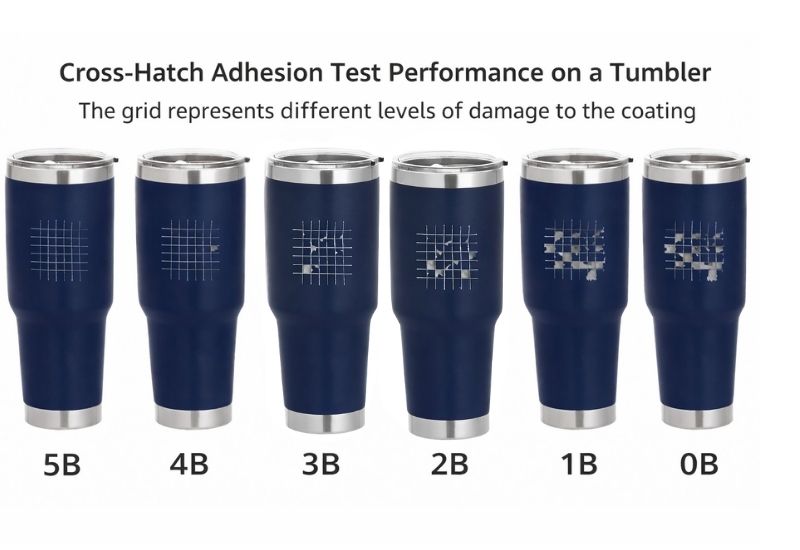
A cross-cut test helps determine whether the powder coating separates easily from the stainless steel surface.
During the test, a small grid is cut through the coating. Adhesive tape is then applied over the grid and removed. The cut area is inspected to see how much coating has detached.
For a non-technical buyer, the important question is simple:
Does the coating remain firmly attached around the cuts, or does it lift away with the tape?
The test is normally performed on a sample because cutting the grid damages the finished surface.
Confirm the Rating System
Different standards use different rating systems:
- ISO 2409 and GB/T 9286 use a six-step classification in which 0 is the best result and 5 is the poorest.
- ASTM D3359 uses ratings such as 5B, 4B and 3B, with 5B representing the best result.
These ratings should not be mixed. For example, a supplier should not describe a result as “ISO 2409 4B.”
Before production, confirm:
- Which test method will be used?
- Which rating system applies?
- What result is acceptable for the order?
- Will the test be performed before or after another durability test?
The required result should be written into the sample approval or quality specification instead of being discussed only after production.
Use Pencil Hardness to Evaluate Scratch Resistance
A pencil hardness test checks how easily the coating can be marked or scratched under controlled conditions.
Special pencils with different hardness grades are moved across the coating. The result identifies the hardness level at which the coating begins to show a defined mark or damage.
This test is useful, but a higher hardness rating does not automatically mean the coating is better in every way. A hard coating may still have weak adhesion, and an excessively brittle surface may perform poorly when exposed to impact or deformation.
There is no confirmed universal 2H requirement for every powder-coated stainless steel bottle. The buyer and supplier should agree on an appropriate pencil hardness requirement based on the coating system, bottle use and project specifications.
When Is a Boiling-Water Test Needed?
A boiling-water test may be useful when a buyer wants to assess how the coating reacts to prolonged exposure to hot water.
After testing, the sample can be checked for:
- Blistering
- Cracking
- Whitening
- Fading or discoloration
- Loss of gloss
- Reduced coating adhesion
However, there is no single test duration that should automatically be applied to every bottle. Possible test periods may range from approximately 30 minutes to two hours, depending on the customer requirement and testing method.
For the projects discussed here, this is generally not a routine factory test for every production batch. The factory may provide sample bottles for testing by the customer or a third-party laboratory.
Before requesting the test, define the water temperature, exposure time, immersion area, sample quantity and acceptance criteria. Without these details, two boiling-water test results may not be directly comparable.
What Can a Dishwasher Test Actually Prove?
A dishwasher test can show how the bottle coating and printed logo respond to a specific washing program. It does not automatically prove that the bottle is permanently dishwasher safe.
One available factory verification method uses:
- A Midea household dishwasher
- The intensive washing program
- Approximately 1.5 hours per complete cycle
- Five to six test cycles
- The powder-coated bottle and logo tested together
After each test, the sample is visually checked for coating changes, surface damage and logo detachment. Photos or video records may be provided when available.
Passing five or six cycles only confirms the sample’s performance under those particular test conditions. It does not predict the result after dozens or hundreds of washes with different machines, detergents and temperatures.
Powder-coated bottles are therefore still generally recommended for hand washing unless a longer dishwasher-resistance requirement has been agreed and independently verified.
The logo method also matters because the logo may fail before the underlying coating. Buyers can compare different custom bottle logo methods before deciding whether the coating and logo should be tested together.
What Buyers Should Confirm Before Production
The most effective way to reduce powder coating problems is to define the test conditions before approving the order.
Ask the supplier to confirm:
- The exact bottle and surface finish
Tests should use the same stainless steel substrate, coating and color intended for production. - The test method
Specify whether the project requires visual inspection, cross-cut adhesion, pencil hardness, boiling-water testing or dishwasher testing. - The acceptance level
Record the required rating and make sure the rating belongs to the named test standard. - The test conditions
For durability tests, define the temperature, duration, cycle, detergent and number of repetitions. - What is being tested
Confirm whether the requirement applies only to the powder coating or to the coating and custom logo together. - The approved reference
Keep an approved physical sample or another clearly identified reference for comparison with bulk production. - The required evidence
Agree in advance whether the supplier should provide photos, videos, an internal inspection record or a third-party report.
A clear requirement is more useful than simply asking whether the coating is “high quality.” When the bottle model, coating, logo method, test conditions and pass criteria are defined before production, both buyer and supplier have the same basis for approval.
For a powder-coated bottle project, provide the supplier with the bottle model, surface finish, intended use, logo process and required durability tests. This makes it easier to determine which tests are necessary before bulk production.